
If you’ve ever pasted text from a font generator into Instagram and wondered why that actually works — because Instagram doesn’t let you install fonts — you’ve stumbled onto something genuinely interesting about how text works on the internet.
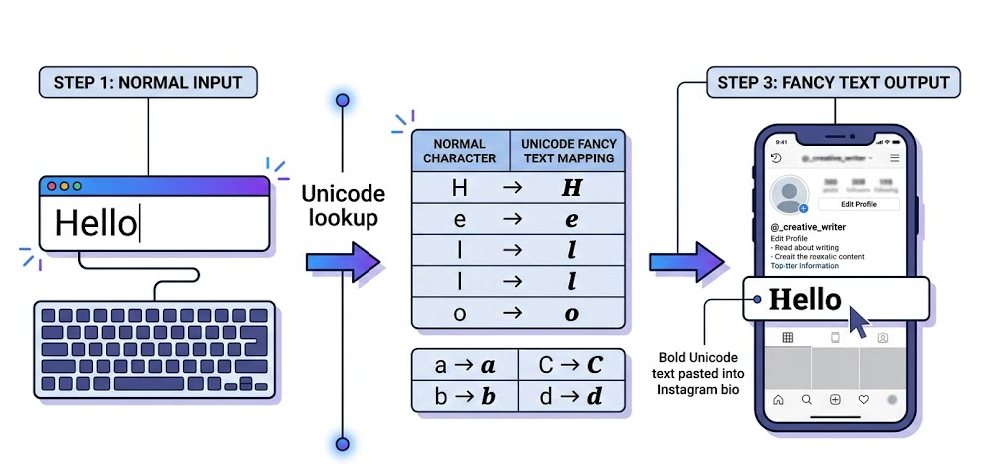
The short answer: those aren’t fonts. They’re different characters. Here’s the longer version, and it’ll change the way you see “fancy text” entirely.
Everything starts with Unicode
When computers communicate with each other, they need a shared agreement about what each character looks like. That agreement is Unicode — a standard maintained by an international consortium that assigns a unique number to every character in every writing system on Earth.
As of 2024, Unicode covers over 149,000 characters: every letter in every alphabet, every emoji, every Chinese character, every ancient Egyptian hieroglyph, and a lot of specialized symbols used in specific technical fields.
One of those specialized fields is mathematics. Academic math papers need bold variables, italic variables, script letters, double-struck letters (like ℝ for the set of real numbers), and Fraktur letters for specific notations. So Unicode includes the Mathematical Alphanumeric Symbols block — a set of characters that are essentially the entire Latin alphabet (and digits) repeated in bold, italic, bold-italic, script, bold-script, Fraktur, bold-Fraktur, double-struck, sans-serif, and monospace variants.
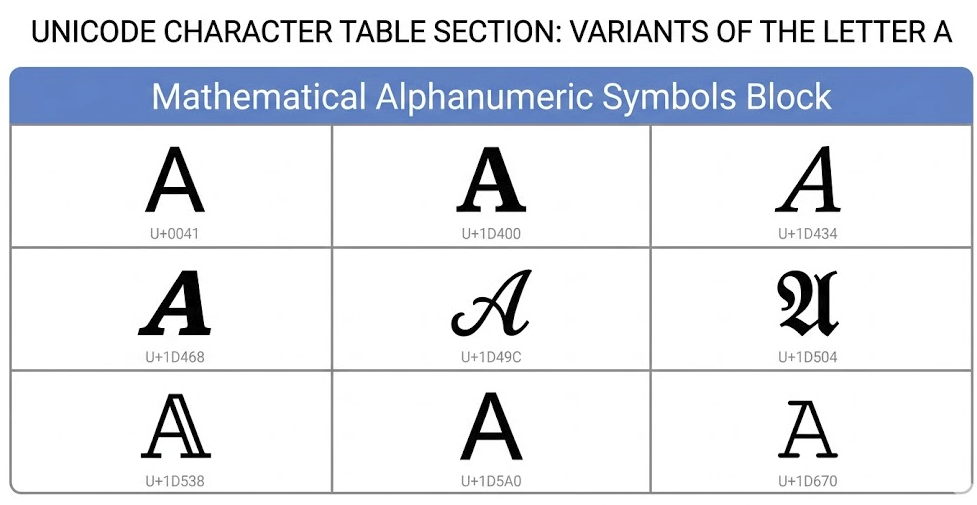
That’s where 𝗯𝗼𝗹𝗱 text comes from. And 𝑖𝑡𝑎𝑙𝑖𝑐 text. And 𝒮𝒸𝓇𝒾𝓅𝓉. And 𝔉𝔯𝔞𝔨𝔱𝔲𝔯. They’re not bold Arial or italic Times New Roman — they’re entirely separate characters with their own Unicode code points, just as different from “A” as “Α” (the Greek alpha) is.
Why this works across every platform
When you type “Hello” in a text field and set it to bold in a word processor, what you’re doing is applying a formatting instruction — a signal that says “render this text in the bold variant of whatever font is currently active.” That instruction travels with the document, but it doesn’t travel with plain text. Copy that bold text out of Word and paste it into a plain text field and the bold disappears.
But 𝗛𝗲𝗹𝗹𝗼 in Unicode mathematical bold doesn’t have bold applied to it. The characters themselves are bold — they’re different code points than H-e-l-l-o. So when you paste them anywhere that renders Unicode (which is virtually every modern app, website, and operating system), the platform just displays those characters as-is. There’s no formatting to strip. The “boldness” is baked into the character identity.
That’s why it works in Instagram bios, Discord messages, Twitter posts, WhatsApp, email subject lines, YouTube channel names, and anywhere else you’d type. It’s just Unicode text.
What a fancy text generator actually does
A fancy text generator is essentially a character substitution table. When you type “hello”, it maps:
- h → 𝗵 (Mathematical Bold Small H, U+1D421)
- e → 𝗲 (Mathematical Bold Small E, U+1D41E)
- l → 𝗹 (Mathematical Bold Small L, U+1D425)
- l → 𝗹
- o → 𝗼 (Mathematical Bold Small O, U+1D428)
And the result — 𝗵𝗲𝗹𝗹𝗼 — is copied to your clipboard. That’s the whole mechanism. The generator does the table lookup so you don’t have to memorize hundreds of Unicode code points.
The other tricks: combining characters
Some effects aren’t from the Mathematical Alphanumeric Symbols block at all. They come from a different Unicode concept: combining characters.
A combining character is one that “attaches” to the character before it, modifying how it looks. The strikethrough effect works this way — the strikethrough isn’t a property of the letter, it’s a separate Unicode character (U+0336, COMBINING LONG STROKE OVERLAY) inserted after each letter. So s̶t̶r̶i̶k̶e̶t̶h̶r̶o̶u̶g̶h̶ is actually the letters s, t, r, i… each followed by the combining stroke character.
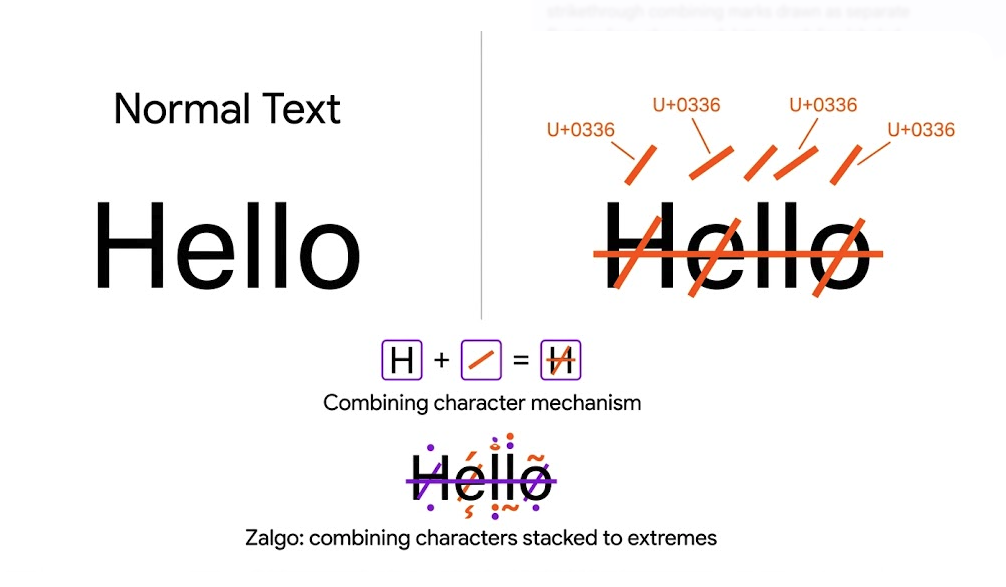
Zalgo text takes this to an extreme. It stacks many combining characters above and below each letter — accents, diacritics, dots, tildes — to create the glitchy, overflowing look. Technically it’s still valid Unicode; it’s just using the combining system in a way it wasn’t really designed for.
Why some platforms block it
Not every platform renders fancy text, and there are a few reasons:
Font coverage. To display a Unicode character, the device or app needs a font with a glyph for that code point. Most modern system fonts cover the Mathematical Alphanumeric Symbols block, but older devices or stripped-down system fonts might not — which is why you sometimes see blank boxes instead of styled text.
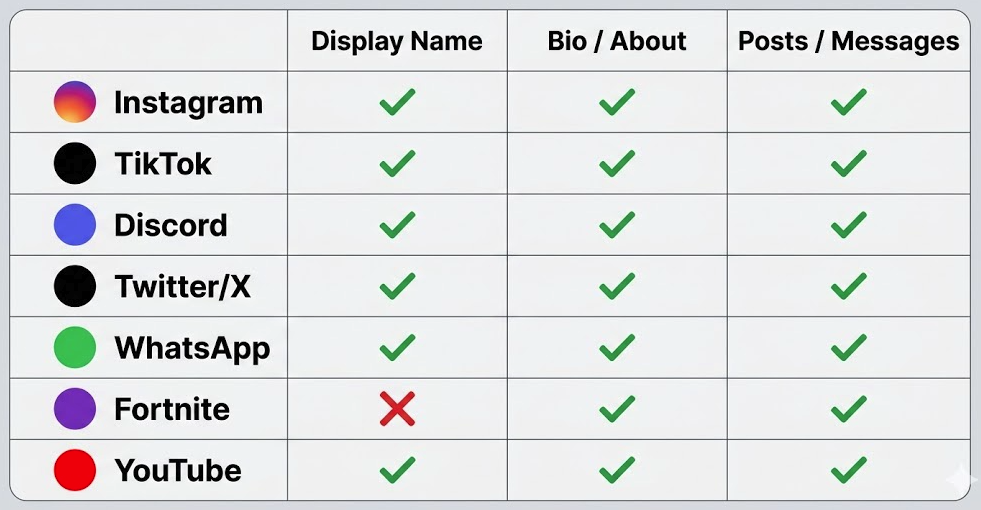
Intentional filtering. Some platforms filter out or normalize certain Unicode ranges to prevent abuse. Twitter/X, for example, sometimes limits certain Unicode in usernames. Epic Games (Fortnite) blocks most Unicode characters in display names. This is a deliberate product decision, not a technical limitation.
Accessibility concerns. Screen readers designed for visually impaired users struggle with fancy Unicode text. A screen reader might read 𝗵𝗲𝗹𝗹𝗼 as “mathematical bold small h, mathematical bold small e…” rather than just “hello”. Some platforms standardize text for this reason.
Does it affect SEO?
In content like blog posts or web page text, yes — using fancy Unicode characters in body text can confuse search engine crawlers. Google reads 𝗵𝗲𝗹𝗹𝗼 and 𝒽𝑒𝓁𝓁𝑜 as completely different strings from “hello”, which means they won’t match keyword searches for “hello”. For social media bios and usernames where SEO doesn’t apply, this doesn’t matter. But for website content meant to rank in search, stick to plain text.
Frequently Asked Questions
Are fancy text fonts safe to use?
Yes. They’re standard Unicode characters — the same technical standard that all text on the internet uses. There’s nothing suspicious or malicious about them. The only consideration is readability and platform compatibility, which we’ve covered above.
Why do some fancy characters look like boxes on my phone?
Your phone’s system font doesn’t have a glyph for that specific Unicode character. Try a different style from the generator — the more common styles (bold, italic, small caps) have much broader font coverage across devices. Very niche character ranges are more likely to show as boxes on older or budget devices.
Can I use fancy text in email subject lines?
In most modern email clients (Gmail, Apple Mail, Outlook), yes — Unicode characters in subject lines display correctly. Some corporate mail servers or very old email clients may strip or mangle them. If you’re sending to a broad list, test with a few common clients first.
What’s the difference between Fraktur and Gothic text?
In the context of fancy text generators, these terms are often used interchangeably. Technically, Fraktur is a specific historical German script style, while “Gothic” refers more broadly to blackletter typefaces. Unicode has both a Fraktur variant (𝔉𝔯𝔞𝔨𝔱𝔲𝔯) and a Bold Fraktur variant (𝕭𝖔𝖑𝖉) in the Mathematical Alphanumeric Symbols block.
Why does copy-pasting fancy text sometimes paste as plain text?
Some apps strip Unicode to plain text on paste — this is intentional behavior in certain coding environments, plain text editors, and some form fields. If your styled text pastes as plain letters, the app is normalizing the input. There’s no workaround for this; it’s the platform’s choice.